Is a Bleach Just a Bleach
The Science Behind Choosing the Right Lightener
There’s a moment most of us have had.
Standing in the color room…staring at shelves lined with tubs and tubes of bleach, all promising something slightly different. Some claim to be faster, others safer, more gentle…some claim to give you 8 stages of lift, some 9 stages of lift, while others make those claims but also offer the shiny promise of an added bonder.
The amount of bleach options can be overwhelming, especially with our wonderful sales reps always handing us something new to try.
It was this exact situation, my sales rep drowning me in so many different bleaches, that made me realize I’d had enough. I needed to take control of the tubs of bleach drowning my color room!
Luckily, I knew just who to contact for clarity on how to decide which bleach was best for me…BCH backed educator and master of bleach, Craig Miller.
I had a list of questions ready for my time with Craig, and I have to say… I never knew talking about bleach could be so much fun. Craig is a bleach genius, but he’s also hilarious, kind, and carries an overall bright energy that somehow brightens a room, even through a Google Meet screen. He’s the rare combination of science and charisma. Basically, he’s super cool.
After speaking with Craig, I found myself feeling less overwhelmed by my bleach options, not because there were fewer of them, but because I began to see bleach differently.
Bleach is more of a decision than it is a product.
Let me explain how I got to this way of thinking…let’s start with the ingredient list.
I read through multiple bleach formulas and noticed they all contained many of the same ingredients, just listed in different orders. So what’s that all about? Craig says the truth lives in the first five ingredients. That’s where we find the highest concentrations, and where we get the real story of what that particular bleach is built to do.
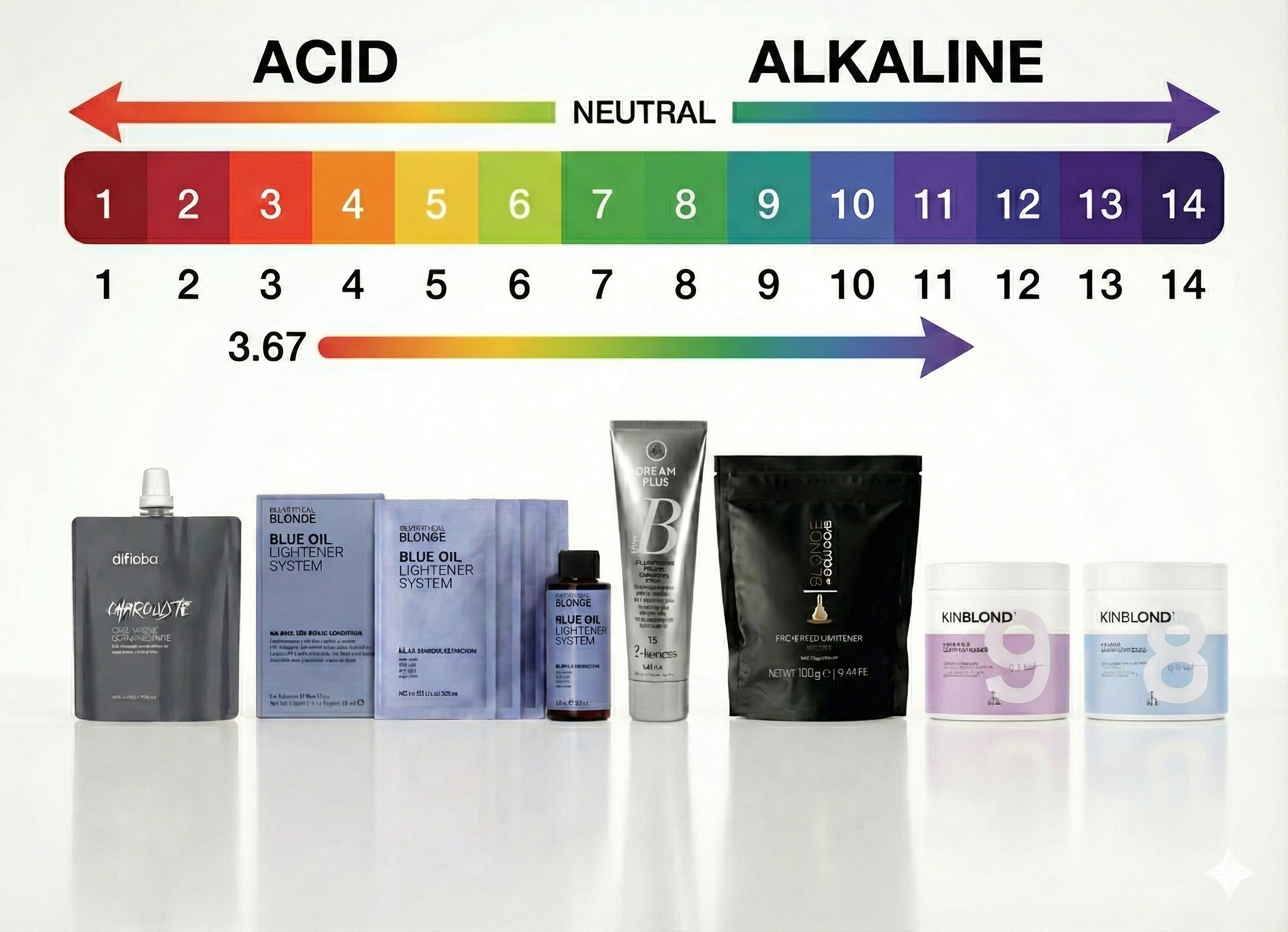
Most lighteners are built from a similar foundation. Persulfates, like ammonium, potassium, or sodium persulfate, are what drive the lift. These are supported by alkalizing agents that open the cuticle, along with buffers or conditioners that attempt to control the reaction and support the hair while it’s being pushed. After those first few ingredients, you’ll often see added oils, starches, or bonding agents. And here’s something important to understand, anything under 1% can be listed in almost any order, which means not everything on the label carries equal weight in performance. This is where awareness matters. Sometimes ingredients are added more for marketing than for meaningful impact. Some ingredients are just added because it’s a talking point for the manufacturer that helps sell you the product.
Now let’s consider the form the bleach takes, because not all lighteners are built to behave the same way.
Powder lighteners are typically your strongest, fastest acting option, designed for maximum lift. Cream lighteners offer a slower, more controlled lift with added conditioning agents, making them feel gentler and more stable, often used for on the scalp applications. And clay lighteners are formulated for open air techniques like balayage, designed to stay where you place them, dry on the outside, and create a softer, more diffused lift.
What Craig helped me understand next is something we tend to overcomplicate, especially when it comes to choosing which manufacturer to buy from. We often think the decision needs to be bigger than it actually is. Beyond ingredients and lift potential, there’s a very real, very practical question we should be asking ourselves…do I actually like working with this product?
How does it mix? Does it go creamy and smooth, or does it stay grainy and stiff? Does it whip up easily, or does it fight you the whole way? Once it’s mixed…how does it move? Does it glide across the hair with intention, or does it drag and skip across the surface? Does it stay where you place it, or does it swell, and shift like it has a mind of it’s own, and you’ve been left out of the conversation?
These things matter more than we sometimes give them credit for. Because behind the chair, consistency is control, and control, when bleaching, is everything. A bleach can promise you 9 stages of lift, but if it doesn’t behave in a way that supports your application style, it’s working against you. So part of choosing a bleach isn’t just about what it does… It’s also about how it works with you while you’re using it.
Bond builders have given us language that feels like protection…repair, rebuild, reinforce. And they do matter…they are an incredible tool in our toolbox!
Most of what we call “bond builders” actually fall into three categories: organic acids, proteins and peptides, and lipids. These are bond-supporting ingredients, not true bond builders. Organic acids can help re-link some broken bonds within the hair, proteins and peptides fill in weak spots and reinforce the structure, and lipids soften and buffer, supporting flexibility and reducing stress during the lift.It’s important to understand that Olaplex is unique in this space. It is the only patented system designed to actively rebuild disulfide bonds and is the only true bond builder. The rest support the hair. They condition, reinforce, and protect, but they do not rebuild bonds in the same way. Bond builders, true or supportive, do not replace judgment. Sometimes, the most skilled thing you can do behind the chair is what you choose not to do, because you know better.
The service of bleaching is not a one size fits all decision and a successful bleaching service isn’t just about what brand or type of bleach you use. Much of your outcome is the result of your application.
We have to ask ourselves.
What is the grade of porosity of the hair I am working on?
What is the natural category of this client?
How much air is in my mix?
How tight is my foil packet?
Where did my application start, and where did it end?
Have I considered heat, both from the environment and the scalp?
What volume am I using?
What results can I expect based on the canvas in front of me?
Bleach is constantly moving and releasing oxygen. So when it swells, bleeds, or shifts… it’s not random. It’s responsive. It’s responding to the conditions we created through our product choice, our mixture, and our application. Which brings me back to the question that started this whole blog.
Is a bleach just a bleach just a bleach?
The answer? No.
Each one is designed with purpose. A clay lightener isn’t trying to behave like a powder. A cream isn’t trying to perform like a high speed lifter. Bleach is a tool. And tools only become powerful when the person using them understands why they exist.
“You can use almost any bleach to get the hair blonde… but what condition is it in when you’re done?” This is the question that Craig says matter. Not which bleach is “best”, but which one aligns with the way you work.
At the end of the day, bleaching is a product you choose with intention. For me, that intention led to a shift…not toward finding the one perfect bleach, but toward building a system. A family of lighteners that live under one manufacturer’s umbrella (because I crave simplicity), each designed for a different purpose…powder, cream, clay…giving me options for whatever walks through my door. Confidence doesn’t come from having fewer options, it comes from understanding the options you choose to keep.
Our goal as haircolorists is to be so grounded in our process and knowledge that the noise of new bleaches and claims can no longer pull us off course… because we know it’s not about any one manufacturer’s bleach. We are the special ingredient that makes it work. We are the power.

Contributor Disclaimer: The product opinions, preferences, and experiences expressed in this article are those of the individual contributor and do not necessarily reflect the positions or endorsements of the Board of Certified Haircolorists (BCH). BCH welcomes diverse professional perspectives and encourages informed decision-making grounded in scientific understanding, practical experience, and professional judgment.